a love letter to the real cup · est. on a roadside in pune
better
chai
Ancient spice traditions. One hundred and ninety years of milk and tea. One man named Shantanu, on a corner in Pune, who taught us why it matters.
play · learn · brew
brew a cup, right here
Tap the ingredients. Watch the kadhai. We'll tell you what kind of chai you just made and where in India it comes from.
1add what calls to you
2then brew
tap an ingredient more than once for more of it
want a real challenge? play the full chai wala game →
seventeen doors into chai
Pick where you wander first. You'll loop back to the others.
What is masala chai?
Start here. What it is, what's in it, how it differs from a café chai latte, and why "chai tea" means "tea tea". The plain answer.
the basics · explainedThe recipe
Real masala chai the way a Pune chai wala makes it. Whole spices, the boil-and-reduce method, the pour from a height. Adjustable for 1 to 12 cups.
15 min · 9 ingredientsThe chai wala game
Run your own stall. Customers come with orders. You brew. Lose all three hearts and the stall closes for the day.
2 min · 20 chai typesMeet Shantanu
The chai wala who started all this. Three chapters of his story, in his own voice, with the wordless film embedded.
a real person · puneChai questions, answered
Why milk curdles, how much caffeine, jaggery or sugar, which tea, can you reheat it. The things people actually ask, answered plainly.
20 questions · straight answersWhich chai right now?
Four questions, one perfect chai. The picker matches your mood, time of day, and spice tolerance to a regional variant.
interactive · 4 questionsThe ancient story
From an Ayurvedic spice-water in a king's court to a glass on a Mumbai railway platform. Nine chapters, nine cities, one drink.
9 chapters · the centuriesWhat to eat with chai
Twelve perfect pairings: vada pav, samosa, glucose biscuits, bun maska, pakora, bhel puri. With the chai each one actually goes with.
12 pairingsThe vocabulary
Every word a chai wala knows. Forty-five terms with phonetics, audio pronunciation, meaning and origin.
45 words · audioChai myths, debunked
The twelve most-repeated misconceptions: chai tea, chai latte, "tea with spices added", and what each one gets wrong.
12 myths · sortedWhat chai does to you
Evidence-based writeup of what each spice actually does. Polyphenols, piperine, ginger, cinnamon, cardamom. No hype.
science · honestHow much does chai cost?
Calculate your annual chai spend. Home: ₹3 a cup. Street stall: ₹15. Global chain: ₹280. The economics, live.
calculator · economicsChai for every season
A different chai for every weather. Monsoon adrak. Winter kadak with pepper. Summer cutting. Diwali saffron. Eight cups, one year.
8 cups · the whole yearThe chai wala's tools
The kadhai, the chalni, the glass, the kulhad, the mortar, the sigri, the spice box, the ladle. Eight tools that make chai, and what to use instead.
8 tools · what each doesChai concentrate
The make-ahead method. One pot on Sunday, a week of chai. The ratios, the storage, six ways to use a single jar.
1 hour · 10 cupsChai around the world
Nine cousins of masala chai. Kashmir's pink noon chai, Tibet's butter tea, Malaysia's pulled teh tarik, and six more.
9 traditions · 1 familyWhy this site exists
The mission, the people, the reason we're pointing at the original cup. And the bigger thing this is part of, called Reweave.
mission · reweavewhere this came from · the long answer
chai is older than you think
Long before the British arrived, in the courts of ancient India, people drank a spiced water called kadha to stay alert through long days. There was no tea in it. There was no milk. Just spices, just water, just intention.
The tea came later. The British planted it in Assam in the 1830s. By 1900 there was too much of it. So the Indian Tea Association set up free chai stalls at railway platforms and factory gates to teach Indians to drink the surplus.
Indians took the cheap broken tea, added milk because tea was expensive and milk was not, added sugar because sugar was cheap, and added the spices they already had in every kitchen. That was the moment masala chai as we know it was born. Not in a court. On a corner.
The British were not amused. They thought milk and spice "diluted" the tea. They were trying to sell a British product. What they got, instead, was the loudest national counterculture in the form of a half-glass on a railway platform. A cup that belonged to India because India had remade it.
Read the full story →the person behind this site
meet shantanu
"I feel a huge sense of joy and satisfaction in running something of my own. I am Shantanu, a proud owner of a tea business. But you can call me 'The Chai Guy'." – Shantanu, Pune, India
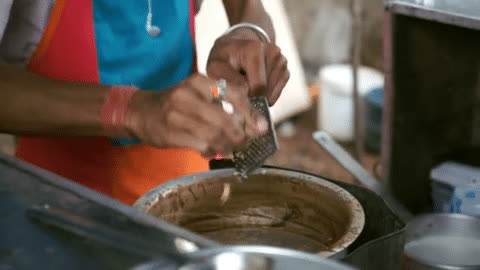
He runs a chai stall in Pune from 5am to 9pm, six days a week. Before chai he drove taxis. He chose glass cups over plastic before it was a trend. His story lives on Reweave as a wordless film and three chapters in his own voice.
the chai questions
Asked enough times that we wrote them down.
What's the difference between chai and chai tea?
Chai is the Hindi word for tea. So "chai tea" is literally "tea tea". The drink most cafes call a "chai latte" is what every Indian household calls just chai, a black tea brewed with milk, sugar and warm spices like cardamom, ginger and cinnamon.
The cafe version is usually made from a sugary syrup. The real version is made on a stove with whole spices in under fifteen minutes. The real version is also cheaper.
What is masala chai?
Masala chai means spiced chai. Masala is the Hindi and Urdu word for a blend of spices. Masala chai is therefore tea boiled with milk and a blend of warming whole spices, most commonly cardamom, ginger, cloves, cinnamon and black pepper.
Every household has a different masala. Some lean heavy on ginger, some on cardamom, some skip cloves entirely. The Indian Ministry of Spices recognises chai masala as a regional specialty with no single canonical recipe. None is wrong.
What is "kadak" chai?
Kadak means strong. A kadak chai is brewed long and dark with the milk reduced into the tea rather than just splashed on top. It's the order you place when you've been awake for nineteen hours.
The technique behind kadak chai is the "boil and reduce" method: bring the chai to a boil, lower it, bring it back up, repeat two or three times. Each rise pulls more colour and flavour from the tea and spices.
What is "cutting" chai?
Cutting chai is a half-glass of chai. Born in Mumbai's tapri culture. The chai is brewed extra strong, served scalding, drunk in three minutes flat.
The name has two origin stories. One says it comes from the act of "cutting" one full cup in half to share between two friends. The other says "cutting" refers to the intensity, sharp and concentrated. Both are probably true.
What's the best tea for chai?
Strong, malty Assam black tea, ideally CTC. CTC stands for Crush, Tear, Curl, a manufacturing process that produces small dark granules. CTC brews fast, brews dark, and holds up against milk and spice. It's what every street chai wala uses.
Loose-leaf orthodox black works too. Avoid delicate teas like Darjeeling first flush; they get steamrolled by the milk.
Is chai actually good for you?
Each whole spice in masala chai earns its place. Ginger is one of the most-studied natural digestive aids, particularly for nausea. Cardamom contains antimicrobial compounds and is used across Ayurveda to ease bloating. Cinnamon has been shown to support insulin sensitivity. Black pepper contains piperine, which boosts nutrient absorption. Cloves are antioxidant-dense. Black tea is one of the highest dietary sources of polyphenols.
None of this is a health claim. It is a four-thousand-year-old Ayurvedic remedy that became delicious by accident. Drink it for the taste. The rest is bonus.
Why does this site exist?
Because chai has been simplified, syrup-ified, and exported as something it isn't. Because the chai wala on the corner makes a better cup than any chain and gets none of the credit. Because the original drink has a ancient story and most of the world has met it through a paper cup with a logo.
This site is a small, deliberate attempt to point at the original. It is part of a larger project called Reweave, which documents people whose work keeps something true. Shantanu is one of them.
Where can I find a real chai wala near me?
If you're in India, you do not need to find one. There is one. They are within walking distance of wherever you are reading this.
If you're outside India, look for small independent South Asian cafes, sweet shops, or restaurants, particularly ones that brew on the stove rather than from a syrup pump. If there's a kadhai bubbling behind the counter, you've found the right place. Order a "kadak chai" and tip well.
a sweet thing you can do · 30 seconds
send a friend a chai
No login. No app. Type a friend's name, write a small note, and you'll get a shareable link that arrives at their phone as a personalised chai card. The whole thing lives in the URL. Nothing tracked.
a footnote, if you want it
If you want to brew this at home with leaves grown by a small ethical farm in Assam, the people we trust are Assamica Agro. We don't sell anything ourselves.